Presidential Palace
Back to all places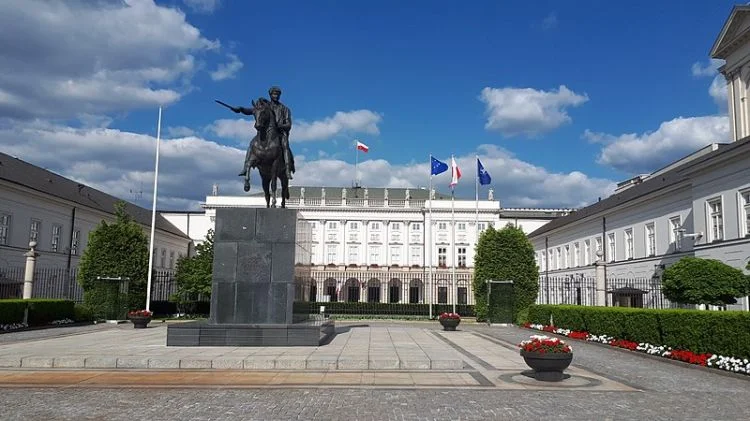
The presidential palace was erected in the 1640s by Stanisław Koniecpolski, the great crown man, and his son Alexander, designed by King Władysław IV, the court architect Constantino Tencalla. Only a few years after the castle was erected, it became the property of the Lubomirski family, and from 1674 it was almost 150 years owned by the Radziwiłł family of the Nieświeska branch. Between 1768 and 1778, it was converted into a theater with King Stanisław August Poniatowski’s box. The palace played a major role in the session of the Grand Seimas; In 1791–1792, the first political party took place there - the May Day of Government Friends. In 1818 it was purchased by the Government of the Kingdom of Congress and converted into a governor’s seat. Then General Józef Zajączek began to live there.
Frederic Chopin, 8, performed for the first time in a palace in February 1818 at a concert organized by the Warsaw Charity. At the beginning of the 19th century, the palace was rebuilt in the Classicist style, giving it its current shape. In 1821, lion sculptures by Camillo Laudini were placed in front of the palace. In 1852, the main part of the palace was almost completely destroyed by fire. The reconstruction was led by Alfons Kropiwnicki, who together with Antonio Corazz built the Bolshoi Theater in Warsaw and reconstructed St. Charles Borromeo Church in Powiązki. After Poland regained its independence in 1918, the palace became the seat of the Prime Minister, and the offices of the Office of the Council of Ministers were located in the side wings.
During the occupation, from 1941 to 1942, the palace was converted into the Deutsches Haus, then a luxury hotel with a casino. As it was not destroyed during the defense of Warsaw in September 1939 and during the Warsaw Uprising, after the end of World War II, and after the elimination of unfavorable changes to its architecture by the Germans, it was able to fulfill its public functions again as Prime Minister and Council of Ministers. In 1955, the Warsaw Pact was signed in the castle, and in December 1970, an agreement on the basis for the normalization of relations between Poland and the Federal Republic of Germany was signed.
From 6 February to 5 April 1989, a round table was held in the Krakowskie Przedmieście Palace to begin the process of democratic systemic change in Poland and throughout Central and Eastern Europe. In 1994, after four years of renovation, a new stage in the castle’s history began - it became the official seat of the President of the Republic of Poland and has since been named after the Presidential Palace.
The turn of the 20th and 21st centuries were marked by important events in our castle calendar for our history. Here, the President of the Republic of Poland signed the Constitution of the Republic of Poland (1997) and ratified the Treaty of Accession of Poland to NATO (1999) and the EU (2003). During its long history, the castle in its current form has been rebuilt and renovated several times. In April 2011 the staircase was renovated. Memorial plaques were also opened on the facade of the palace. In February 2010, on the 192nd anniversary of Frederic Chopin’s first public concert at the palace, a memorial plaque was unveiled. In September 2010, the President of the Republic of Poland, Bronisław Komorowski, unveiled a plaque at the chapel commemorating all those involved in the President’s Office, as well as representatives of the National Security Bureau who died in the disaster near Smolensk. On the first anniversary of the Smolensk disaster, a memorial plaque was unveiled in the palace chapel to commemorate the chaplain of President Lech Kaczyński, Roman Indrzejczyk, who was tragically killed in the Smolensk disaster. The main hall is relatively modestly furnished. Its main decorations are a marble fireplace, a baroque Gdańsk-style wardrobe and the January painting in Suchodolsk entitled "The Death of Cyprian Godebski in Raszyn". The guests are welcomed in the main hall on behalf of the President of the Republic of Poland. The President personally welcomes only the Heads of State.
The hall offers views of ten works by Jerzy Nowosielski, including abstract works, landscapes and Orthodox monasteries. Born in 1923 and died in 2011, Jerzy Nowosielski was one of the most prominent figures in Polish contemporary culture. Painting, theology, art teaching and involvement in promoting and supporting Polish art are just a few examples of the disciplines in which Jerzy Nowosielski excelled. The Chapel of the Annunciation of the Blessed Virgin Mary is a place of prayer for the President, the President, the Chancellery and the invited guests. The walls have gifts from the popes: John Paul II and Benedict XVI, as well as a cross-section of the remains of the towers destroyed by the World Trade Center in 2001.
Next to the cross is a plaque dedicated to the attacks in New York, the words of the psalm engraved on it: "Thou hast made the earth to tremble, thou hast broken it: repair it broken, for it trembles." There are memorial plaques on the floor at the place of prayer of John Paul II and Benedict XVI. On the wall there are memorial plaques near Smolensk in memory of the officers of the Office of the President and the Office of the State Security and the Chaplain of the President who died in the disaster. priest Roman Indrzejczyk. The chapel also houses the peace of peace from Bethlehem, which scouts give to the president each year. The Rococo hall is called feminine because of this decor. When the heads of state hold talks in the White Hall, their wives in Rococo Hall are waiting for them to end. The presidential women, who are usually engaged in charitable activities, host their guests in this hall. It also happens that the President distributes souvenirs to his guests in this Chamber.
The White Hall is the most important hall of the Presidential Palace. The head of state will host foreign heads of state in this hall. The hall is located on the main entrance axis, so after greeting the President in the courtyard, we move on to the White Hall for the first talks. Only the most important people take part in these talks, not the whole delegation to the palace. 17th and 18th century paintings and porcelain vases in Miśnia are the decorations of this hall. In the dining room, the President will host a gala lunch for his guests. It also happens that the head of the cabinet or the head of the office meets important people here, with whom the president cannot meet on a specific day. The Blue Hall hosts major conferences and hosts external delegations. In the middle of the table placed in this room is a seat for the President of the Republic of Poland. There are two important portraits on the walls - Prince Poniatowski and Tadeusz Kościuszko. A staircase connects the Hetman Hall with the vestibule and the pillar hall. At the foot of the stairs is a sculpture of Pius Wieloński’s "Prometheus".
The name of the antichambre comes from French and means the welcome room in front of the ballroom. If the column hall used to be a ballroom, the arrival of the next guests was announced there. Today, it is a kind of hall from which you can pass both the head of the State Secretariat and the office of the head of the Polish President’s Cabinet. It continues to be a place where guests are greeted before the President’s gala dinner in honor of the Heads of State on an official visit to Poland. This is a special ceremony where guests stand in line with first and last name cards. Before greeting the heads of state, the cards are handed over to the protocol manager, who reads the first and last name. From there, guests move on to the Column Hall. The Column Hall (ballroom) is the largest room in the Presidential Palace, best known for its television reports. All ceremonies with a larger number of people will take place in this room. It is the place where the president appoints and dismisses governments, gives scientific titles, appoints judges, ranks general, the highest state decorations and orders. This room also witnessed important events in the recent history of Poland. Here, in 1955, the authorities of the Polish People’s Republic, the Soviet Union and other communist bloc countries signed the Warsaw Pact. In 1989, government representatives met with opposition representatives in a round table in the room. Ten years later, on 12 March 1999, the Treaty of Accession of Poland to NATO was signed here, and on 23 July 2003, the Treaty of Accession of Poland to the EU.
The chandelier in this room consists of 5 rings and 80 candles, with 3600 crystals at the bottom of the chandelier. In the 19th century, the chandelier was lit with gas. The carpet was changed in February 2009. Previous was 40 years old. The new carpet covers an area of 185 square meters and was designed by the renowned artistic knitting specialist Professor Jolanta Rudzka-Habisiak and created by the carpet factory "Agnella". Festive dinners are held in this room in honor of the Heads of State. Interestingly, in the diplomatic protocol, breakfast is similar to a traditional dinner and starts at about 1 pm and lasts about 2 hours. Dinner is considered to be a dinner during which the host makes an official toast in honor of the hosted guests.
The banquet hall (painting hall) was named after the number and size of the paintings exhibited here. A reception will be held in this hall during important ceremonies, national celebrations or important nominations. Judges, professors, generals, or newly appointed members of the government come here from the column hall. The banquet hall is also the seat of the Cabinet Councils - government meetings chaired by the President of the Republic of Poland and credentials of the newly appointed ambassadors. The banquet hall is also used as a venue for conferences and meetings of the President with the media.
The winter salon (winter garden) is a new room created in 2000 by covering an unused terrace. It now embodies the connection between separation and modernity. Stained glass windows symbolize the seasons. Guests are offered snacks and there are often behind-the-scenes conversations in this part of the palace after the celebrations. The interior is decorated with two sculptures: the marble Wiktor Brodzki’s "Psyche with doves" from 1881 and Pius Weloński’s "Snowball Tree" from 1896. The round table was located in the column hall during the talks. It is currently located in the right wing of the Presidential Palace, as the column hall is in constant use. On 6 February 2009, at a celebration of the 20th anniversary of the talks, the table was moved to the Column Hall again. The International Conference on the Condemnation of Terrorism, which took place after the attacks of 11 September 2011, was also held behind this table. Since February 2009, history classes have been held here for students in Warsaw schools.
https://www.president.pl/presidential-residences/presidential-palace
Photo: Rakoon
52.24317, 21.01661