The Royal Castle in Warsaw
Back to all places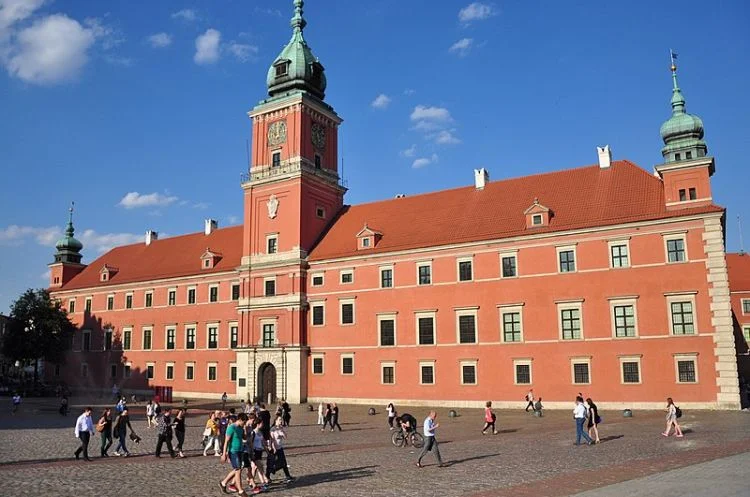
Located on the banks of the Wisła River, the castle was erected as a defensive structure. For centuries, it was the most important royal residence, but it also became an important location in the history of Polish culture. There are many important dates in the history of the royal residence in Warsaw. One of them is certainly the year 1568, when King Sigismund II Augustus, together with his court, moved from Kraków to Warsaw and settled in the Royal Castle, simultaneously executing its radical extension and reconstruction. Shortly afterwards, in 1596, Sigismund III Vasa officially moved the capital to Warsaw, making the castle the most important royal residence.
However, the existence of this building, which is extremely important for history and culture, starts much earlier. According to known historical documents, the first princely seat on the site of today’s Royal Castle was erected at the turn of the 13th century, so more or less at the same time as the establishment of the city of Warsaw. Already at the end of the 13th century, a castellan’s castle surrounded by a moat was to be found on the Wisła promontory. During the next half-century, when the settlement gained in importance and became the seat of the dukes of Mazovia, the wooden castle was transformed into a brick one. Probably in the middle of the 14th century the oldest preserved part of the building was built, the so-called Great Tower, also known as the Grodzka Tower. The basement and ground floor parts still exist from the square-plan, four-storey defensive building.
Subsequent stages of the building’s expansion are connected with the development of Warsaw – the castle took on its Gothic forms in the first decades of the 15th century when Prince Janusz I the Elder moved the capital of the Duchy of Mazovia from Czersk to Warsaw. It was thanks to him that between 1407 and 1410, a three-storey brick palace, the so-called Great House (Curia Maior) was built here, housing not only the princely suites but also the hall used for many years as the venue of the Mazovian Sejm sessions.
However, the greatest transformation of the Warsaw princely residence took place in the second half of the 16th century, thanks to Sigismund Augustus, who chose the Warsaw building as his new residence. He entrusted its expansion to renowned architects of the time, the Silesian Jakub Parr (who had just before turned the castle in Brzeg into a pearl of Renaissance art) and the Italian Giovanni Baptista Quadro, the creator of the Poznań town hall. When the Renaissance architects began work here, the Warsaw castle consisted of the Great House with the Grodzka Tower, the southern building and the Minor Court.
As part of the reconstructions and extensions started in the second half of the 16th century, amongst others, the New House was built, which housed the king’s private flats, the Great House was transformed into a parliament building, the Lesser House was rebuilt for the needs of Anna Jagiellon (amongst others, a large dining room and a chapel were created here) and the whole establishment was given a more coherent expression. Work on the transformation of the castle from a mediaeval defensive structure into an ornamented royal residence continued in subsequent years when successive Italian architects were engaged in rebuilding the castle interiors.
https://culture.pl/en/work/the-royal-castle-in-warsaw
Photo: Nieszka
52.24798, 21.01526