Ujazdów Castle
Back to all places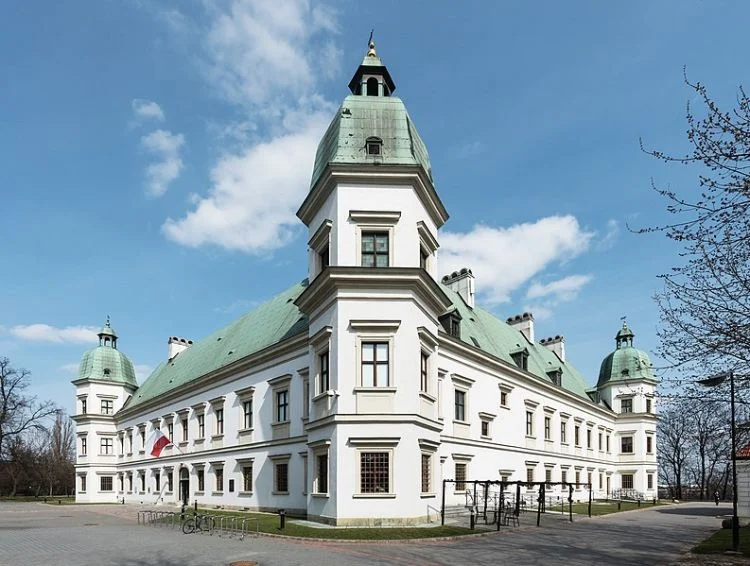
Ujazdów Castle is a castle in the historic Ujazdów district of Ujazdów Park and the Royal Parks in Warsaw. It dates back to the 13th century and was rebuilt several times. Like many Warsaw buildings, it suffered much damage during the Warsaw Uprising (1944). Reconstructed 30 years later (1974), the building now houses the Warsaw Center for Contemporary Art. The first castle was erected on the site by the Dukes of Masovia as early as the 13th century. However, in the next century, their court was moved to the future royal castle in Warsaw, and Ujazdów Castle was neglected. In the 16th century, a wooden mansion was built there for Queen Bona Sforza.
The ruins of the castle of the Masovian princes were then merged with a new fortified manor, built by King Sigismund III Vasa for his son, the future king Władysław IV Vasa. However, there is little evidence that the residence was ever used by a young prince who spent much of his youth in his father’s court. Between 1659 and 1665, the building housed Titus Livius Boratin’s mint, who created his famous copper coin boratynka there. The neglected castle was bought in 1674 by Stanisław Herakliusz Lubomirski and then rented by King Augustus II, who ordered the construction of a new royal residence. The castle, which included much of the site’s earlier buildings, was built by Tylman of Gameren, a prominent 17th-century architect and engineer. The gardens surrounding the castle, which were later divided into two separate parks, were renovated. Around this time Łazienki Eremity and Łazienki Palace were built.
The design of the castle was further changed by King Stanisław II August, who in 1764 commissioned Jakub Fontana, Dominik Merlin, Jean-Baptiste Pillement and Efraim Schroeger to renovate it. The east and west façades were raised with the addition of a second floor, while the outbuildings after Gameren were rebuilt to the height of the main building, creating a large courtyard. Around this time, the castle also belonged to the so-called Stanislav axis, a series of parks and palaces planned on the southern edges of Warsaw, like the Saxon axis of the city center. The reconstruction of the palace was almost completed by 1784, when the work was completed and the building was donated to the Polish army.
Therefore, between 1784 and 1789, the castle was rebuilt, this time by Stanisław Zawadzki, who turned it into a military barracks. The outbuildings were significantly enlarged. Since then, the building housed the Lithuanian Infantry Regiment and the 10th Infantry Regiment. During the Kościuszko Uprising, the castle was the main military service in the 20th Foot Regiment. After the partition of Poland, during the occupation of Warsaw by the Prussians, the building was abandoned. After the proclamation of the Duchy of Warsaw, it was restored to the military and turned into a military hospital. However, plans to turn this Polish army into a central hospital were postponed by the Vienna Congress, which handed over the Polish Congress to Russia. On April 1, 1818, the hospital was officially opened. It housed up to 1,000 wounded soldiers. Following the outbreak of the November Rebellion, the hospital was expanded to 1,250 beds and an additional 600-seat building was opened in the nearby Łazienki complex.
After the uprising, the Russian garrison in Warsaw was significantly strengthened, while Polish troops were disbanded. A new military central hospital was built next to Ujazdowski Park and the castle became more of a Russian barracks. Around 1850, Jerzy Karol Völck rebuilt the auxiliary buildings, but 20 years later they were partially demolished. After the outbreak of World War I, the building was again converted into a temporary hospital by the Russians. He was imprisoned by the German army in 1915, transferred to the Polish legions on April 10, 1917, and became the main military hospital for Polish units fighting alongside the central authorities.
After Poland regained its independence in 1918, the interior of the castle was changed again. Since the 1920s, it has housed several parts of the Warsaw NCO School. The main staircase was restored with a representative 18th century design. An interesting feature of the stairs was a set of stone slabs placed on May 15, 1927, commemorating the names of all known Polish military medics who perished in the wars of 1797-1920. Additional plaques resembled Karol Kaczkowski, Zdzisław Lubaszewski and Edwardian sculpture. Wittig remembers all military medics. After the Polish Defense War of 1939, the Red Cross organized a school for WIA soldiers. The castle was burned down and damaged by the Germans after the 1944 Warsaw Uprising.
After the war, the building was to be converted into a military headquarters. However, work did not begin as the castle was demolished by the Polish communist authorities. In 1975, however, green light was given to the reconstruction of the castle according to the design of the 18th century, and the Piotr Biegański project was chosen. The castle currently houses a Center for Contemporary Art, with collections and temporary exhibitions, concerts and workshops.
In 2017, Piotr Bernatowicz was appointed director of the Polish Minister of Culture, Piotr Glinski, a member of the Law and Justice Party. In an email interview with the New York Times, Bernatowicz said he said "the left-wing, precisely neo-Marxist ideology of the Polish art world is dominated ... Artists who do not embrace this ideology are marginalized." to promote artists with different views: conservative, patriotic, family, and plans to make the museum the last battleground in the Polish Cultural Wars, which opposes liberals against the ruling populist Law and Justice Party, as well as other conservative groups. Ujazdów Castle features a number of well-known artists.
https://placeandsee.com/wiki/ujazdow-castle
Photo: Adrian Grycuk
52.21960, 21.03046